
Ducks and Beavers – How Landowners are Coexisting with Nature
Historically and today, wetlands pose challenges and inconveniences for landowners, including standing water in fields from drainage ditches, lower crop yields due to wetlands, and flooding caused by beavers. To address these issues, many landowners have chosen to remove wetlands from their property to maximize production. Such actions have environmental impacts on watersheds, including increased nutrient loading, reduced tolerance to pollution, and decreased biodiversity. Wetlands have many functions within a landscape, including filtering water, replenishing groundwater, mitigating flooding, and providing habitat requirements for a large diversity of wildlife. From an agricultural standpoint, wetlands are also important for providing water for crops and rangeland and for preventing erosion, which are excellent benefits for landowners. Organizations like ALUS collaborate with landowners to balance agricultural production with ecosystem maintenance by implementing land-use change projects, such as creating, restoring, and enhancing wetlands.

“Where agriculture and nature meet” is the motto driving the ALUS program. The non-profit society aims to provide community and landowner developed programs to restore and enhance nature, build community resilience, and fight climate change and biodiversity loss. In the County of Vermilion River, ALUS launched its first program in Alberta in 2010, at the Cattlemen's Corral in Lloydminster. From there, the program has worked with 60 landowners on 88 projects totaling 4833 acres of land across the County to create and maintain projects, including riparian buffers, wetland restoration, habitat enhancement, and beaver management projects, like pond levellers. ALUS accomplishes these projects through funding from grants and foundations, such as the W. Garfield Weston Foundation, to allow farmers and ranchers to have control over the projects they decide on and to see their development all the way through.
Additionally, many projects that restore agricultural or grazing land to natural habitat include annual payouts for transforming previously farmed or grazed land back into its natural state or for adopting and maintaining Beneficial Management Practices (BMPs). What's more, there is no limit to the number or type of projects farmers and ranchers can have on their land; it's entirely up to them what they want to see happen.
Chris Elder, the Environmental Services Coordinator for ALUS in the County of Vermilion, guided a tour of three ALUS project sites for a group of Lakeland College students. The first site was the Mead Family farms, where Chris spoke to students about a water restoration project undertaken by ALUS in collaboration with the Mead Family. On the farm, there is an ephemeral draw (a type of temporary watercourse) that crosses through a section of cropland. When cultivation on this portion of their land was no longer beneficial, the Mead family partnered with ALUS to replace the crop cover in that section with perennial vegetation. This project delivered a range of benefits for both landowners and the surrounding environment. For landowners, this newly revegetated patch slows and retains surface water, replenishing groundwater and helping prevent erosion and support crop production. The environmental benefits include cleaner water drainage into Campbell Creek and Campbell Lake, and the creation of habitat on the farm for an array of wildlife. In the springtime, ducks and geese use the ephemeral draw to feed, and tree swallows have been spotted building nests near the area. The project has proven to be a successful collaboration between ALUS and the Mead Family, finding a beneficial balance for both the landowners and the natural world surrounding their farm.
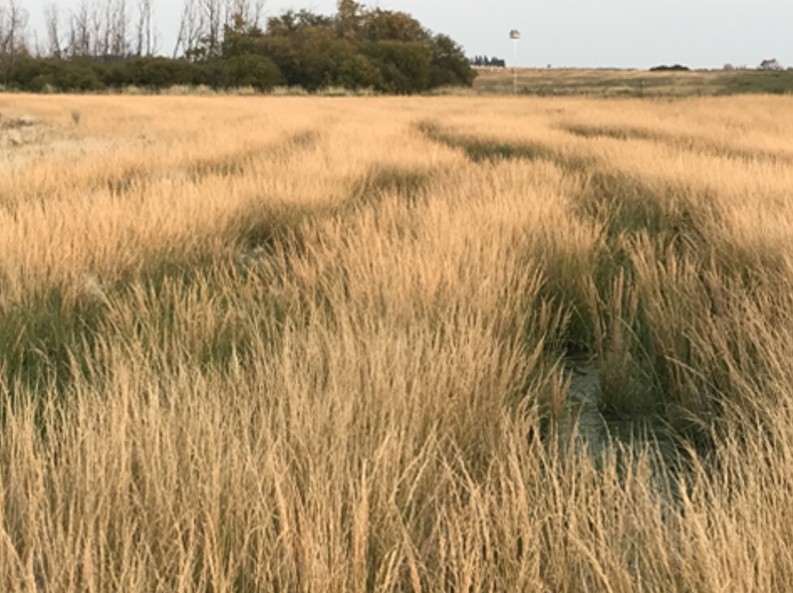
Jim Mead and Francey Repp
LandownersThe Bingham’s ALUS wetland restoration site we visited demonstrates how land use directly influences ecological recovery. Over the years, many wetlands have shifted from permanent to ephemeral due to drought. Despite this, the wetland restoration is a long-term investment. The wetland soils continue to function as natural water sponges, and key vegetation—such as cattails, sedges, and willows—persists along the margins of the wetland. When moisture returns, these systems are expected to bounce back quickly. To support this resilience, the landowner and ALUS implemented some building strategies. In 2017, volunteers planted tree and shrub species to mimic a forest system. The plants now act as shelterbelts, provide habitat for wildlife, and buffer the wetlands. The landowner initially attempted to attract pollinators with clover species, but heavy winter deer browsing destroyed it. After it failed, this prompted a shift toward more sustainable and diverse planting. Before 2008, the area was cultivated, with little wetland vegetation and structural diversity. After purchasing the land, the landowner decided to convert the area to tame pasture because of the cattle. ALUS installed riparian fencing to manage when and how cattle access sensitive areas. By carefully timing rotational grazing, the landowner protects riparian edges, reduces trampling, and allows wetland vegetation to re-establish. Even in drought conditions, these management practices help rebuild the wetland’s natural filtration capacity, stabilize soils, and support long-term ecological function. The Bingham site also includes duck nesting tunnels, also known as hen houses. WFC students from Lakeland College installed the duck nest tunnels in March 2022; they provide safe, elevated nesting opportunities for mallard ducks by keeping their eggs out of reach of land-based predators. Due to the drought, the tunnels are not heavily used now - ducks tend to nest close to standing water – but their value will increase significantly once water levels rise. As water refills in spring, these hen houses will enhance waterfowl habitat and contribute to a more diverse wetland complex.

Larry and Roseanne Bingham
Landowners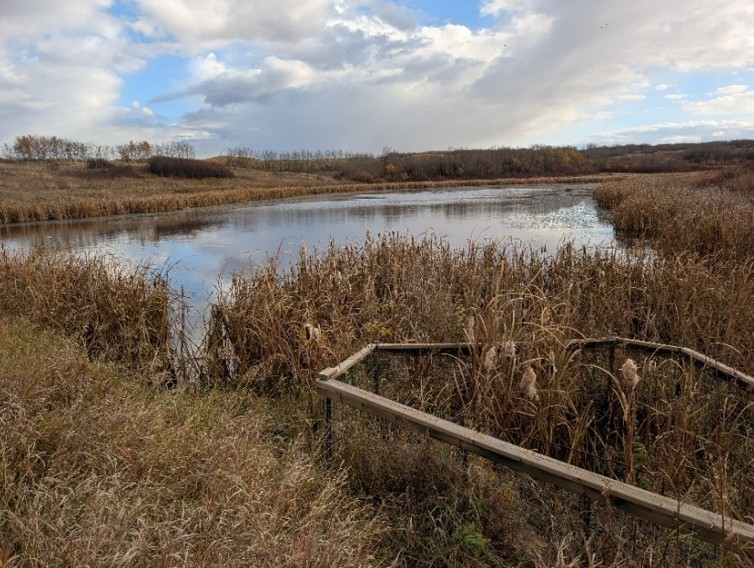
Since 2010, Doug and Cheryl Livingstone have been ALUS participants with a total of 260 acres enrolled in the program. The most notable project on their land is a device called a beaver deceiver, installed after consistent damming of a culvert caused flooding and damage to the adjacent roadway. The beaver deceiver consists of a trapezoidal cage and a perforated pipe that confuses beavers and deters them from damming the culvert, while regulating water flow to prevent flooding that could wash out the road. This form of management preserves the local biodiversity, including the beaver family living within the area. While they can be damaging to infrastructure, beavers are incredibly important to the ecosystems they inhabit and support critical landscape functions, including climate resiliency, groundwater storage, stream permeance, water quality, and habitat creation. These functions also support the resiliency and health of agricultural and grazing lands, supporting farmers and ranchers in the long run.
If you are a landowner or know someone who is, and you struggle with flooded fields, decreased land productivity, wildlife issues, or any other land-use issues that require change. Consider partnering with ALUS to create land-use projects that benefit you, your land, and the surrounding environment.
Frequently Asked Questions
What makes ALUS unique?
ALUS is completely community-developed and farmer-driven, making it local to the people who understand producers' needs best. ALUS also provides long-term support to participants in the form of technical resources and networks, as well as acre-based annual payments for project management and maintenance.
How can I apply to the ALUS Program?
There is no formal application or ongoing reporting forms to fill out. Contact Christ Elder directly at celder@county24.com or 780.853.7844, and he will meet with you to review your project ideas and discuss how ALUS can support your plans. Once a proposal is created, the project is presented to the Partnership Advisory Committee for recommendations and approval.
Where does ALUS funding come from?
ALUS National acquires funding from Federal and Provincial grants, philanthropic foundations, corporate social responsibility programs, and other partner organizations. The funding is pooled and distributed to ALUS communities across the country to support local producers directly.
What happens if changes need to be made to the project once it has already been established?
In most cases, ALUS will work with the producer to find solutions that work for the operation and nature, allowing the agreement to continue in a modified form. Alternatively, as ALUS agreements are voluntary and flexible, they can be terminated at any point.

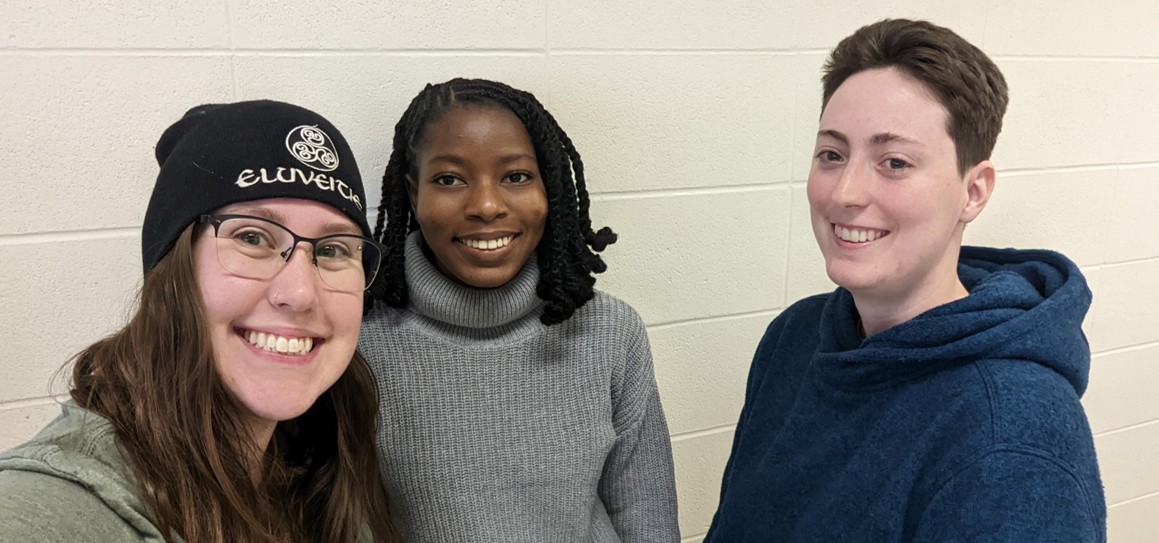
Danielle MacDonald is a recent Lakeland Graduate who completed the Wildlife and Fisheries Conservation Program. She has worked as an Environmental Consultant and Stream Crossing Technician. She has hopes to pursue a career in wildlife and habitat protection.
Eunice Dakurah moved to Canada from Ghana two years ago to pursue studies abroad. She completed the Renewable Resources Reclamation diploma and hopes to gain experience in the environmental sector in North America.
Julia Porter is also a previous Lakeland graduate who completed the Wildlife and Fisheries Conservation program. They are the co-conservation coordinator with the Alberta Amphibian Reptile Conservancy and hope to pursue a career working in aquatics.
We are Lakeland College students in the Bachelor of Applied Science in Environmental Monitoring program. As part of an assignment for our Aquatic Habitat Protection class, we were tasked with creating a blog post that addresses the beneficial impacts organizations such as ALUS have on the Vermilion watershed. Shoutout to Chris Elder for giving us a tour of these sites and for discussing the tremendous environmental impacts these collaborative land-use change projects are having in the Vermilion County area. We would also like to thank our instructor, Dr. Nicole Nadorozny, for her guidance and assistance in creating this blog.